Garden Pond History: From Formal Ornament to Wildlife Habitat
Garden pond history shows how design choices shape a pond’s role, helping you understand the trade-offs between a clear focal point and wildlife habitat.
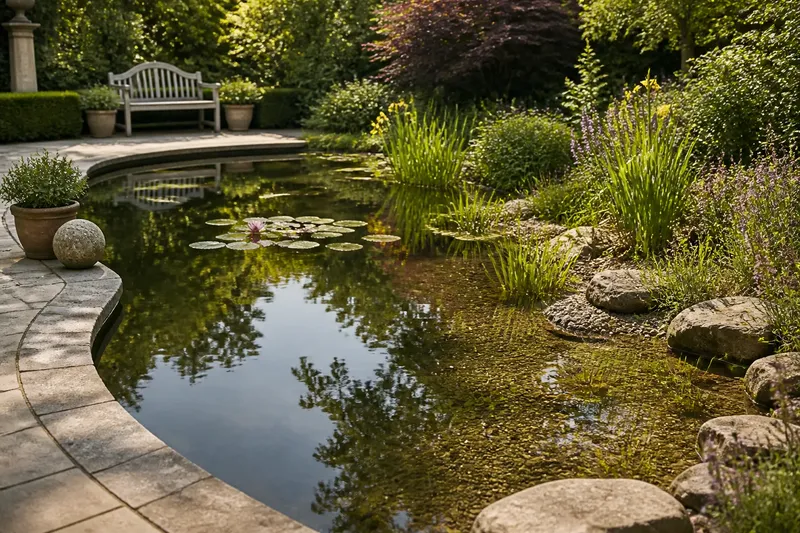
Why does one garden pond have a crisp, reflective surface while another has planted shallows and a less uniform edge? Garden pond history is not a single story of one style replacing another; it is a way to read the different purposes people have given ponds. A pond can be arranged as a visual feature, shaped to offer habitat, or designed to do both.
Water as display
A formal pond can work like an element of garden architecture. A defined outline, a prominent position and a neat edge connect it to paths, terraces or clipped planting. Its reflection becomes part of the view, and its orderly shape helps compose the surrounding space.
That visual role does not prevent a pond from supporting life. However, a design that prioritises an open surface and tidy margins may offer less varied shelter than one with planted shallows. The distinction is about emphasis: is the water chiefly arranged to be seen, or is its planting and edge also planned as habitat?
Shape alone cannot answer that question. A small pool can be a focal point in a domestic garden, while a larger pond can be designed with wildlife in mind. Position, planting, water access and ongoing care all affect what the feature offers.
Garden ideals vary
There is no need to claim that every garden followed the same historical sequence. Formal and informal approaches can be found in different settings, and a curved outline does not by itself tell us when a pond was made or what its owner intended. The safer way to read a pond is to examine its design rather than assume that one style replaced another everywhere.
An irregular edge can make water appear less controlled, but appearance is not the same as ecological function. A steep, uniform bank may leave few shallow places, and a bare margin may offer little shelter, whatever the pond’s outline. A design that looks natural can still have limited habitat variety.
Thinking about a garden as part of its surrounding living environment offers another way to judge a pond. Instead of assessing only the reflection or symmetry, a gardener can consider whether the water provides different conditions for plants and animals. That means looking at depth, margins, cover and how the pond connects with the rest of the garden.
Habitat by design
A wildlife-minded pond is not simply an ornamental pond abandoned to grow. It is a deliberately varied space, with features that can provide places to shelter, feed or reproduce. Locally suitable plants and a gently sloping margin may help create that variety, although the right choices depend on the site and local conditions.
Some plant growth or fallen leaves may be part of a pond’s seasonal character, but unchecked growth can also reduce open water. Ecological care is not the same as doing nothing. The practical aim is to retain a mix of conditions rather than let one feature, such as dense growth, dominate the whole pond.
Imagine a homeowner with a small, clear pond edged entirely by paving who would like to make part of it more welcoming to wildlife. They keep the main reflective area open, remove paving from one section, and create a gently sloping, planted margin with suitable local plants. The observable result is a more varied edge and additional cover, while the pond still has an open area; which animals visit remains dependent on local conditions.
Reading a garden pond
Many ponds combine visual and habitat goals. A gardener might want a clear view across the water while also making one edge shallower and more heavily planted. These choices involve trade-offs: a crisp, open edge may be easier to keep visually tidy, while varied planting can soften the view and provide more cover.
Use these observations to decide what to preserve or change. For each feature, consider the result and choose the action that fits the pond’s intended role:
- Outline: If the edge is geometric and you want a formal focal point, retain its shape; if you want a softer transition, add planting along a suitable section rather than assuming an irregular outline alone will create habitat.
- Margin: If the bank is steep or hard-edged and wildlife access is a priority, consider creating a safe, shallow transition; if that is impractical, keep the edge as it is and explore other ways to add shelter.
- Planting: If the surface is open and you want more cover, add suitable plants to part of the margin; if growth is already dense, thin it carefully to retain some open water.
- Visibility: If the pond is a focal point and that is the main aim, keep a clear sightline from the usual viewing place; if you want a quieter habitat area, allow planting to frame a less prominent section.
- Maintenance: If regular tidying removes all cover, leave some suitable growth while keeping access and open water; if plants are overwhelming the pond, manage them gradually rather than abandoning care.
- Surroundings: If nearby planting offers little shelter, add suitable cover around the pond; if the surrounding garden already provides it, focus on improving the pond’s own edge and variety.
Say you inherit a paved pond with an open centre and a steep edge, and you want to keep its reflective view while improving its habitat potential. First, you note that the centre is already open, so you decide not to fill it with plants. Next, you identify one accessible section of the paved margin where a shallow transition could be made; if the pond’s construction makes that change unsuitable, you choose planting beside the edge instead. Finally, you add locally appropriate plants to that section and leave the rest of the surface clear. The resulting design keeps the main reflection and introduces a more varied margin, without assuming that wildlife will arrive or that the new planting suits every site.
What do garden ponds tell us?
Why were garden ponds designed as ornaments?
A pond can complement paths, buildings and planting as part of a composed view. Its outline and reflective surface make water a visible element of the garden’s design.
Does an informal pond support more wildlife?
Not automatically: an irregular outline can still have steep banks, little cover or unsuitable planting. Habitat depends on the conditions within and around the water, not on shape alone.
Can a pond serve beauty and habitat?
Yes, if the design makes room for both open water and a more varied margin. A clear central view can coexist with plants and gentler access along part of the edge.
How should I interpret an older pond?
Look at its outline, margins, planting and upkeep rather than assigning it to a period based on appearance alone. These features offer clues to its uses, but they cannot establish its history by themselves.
A pond’s purpose
Garden pond history is most useful when it helps you ask what a particular pond is meant to do. Its shape may suggest a visual intention, while its edges and planting reveal whether habitat has also been considered. Before changing an existing pond, decide which qualities matter to you, then adapt one suitable part at a time; where construction or local wildlife rules raise questions, seek advice from a qualified local professional.